
News & events
12/07/2007 — Discover the “treasures” of Milos!

- Designed for children and teenagers (9-14 years old)
- Developed in 2007 in cooperation with the organization “Technotropia – Politismos” a private organization that designs cultural products and activities aiming to promote Greek cultural heritage and modern Greek culture
- The program has been designed
- to familiarize the children with the Museum/s exhibits
- to acquaint them with the rocks, minerals and ores linked to the island/s mining activity throughout its 11,000 year history
- to make them aware of the defining role that the mineral wealth of Milos played in shaping local society, culture and social & economic development, and
- to help them discover important elements of the island/s cultural heritage.
12/05/2006 — Colors & Aromas
- Designed for elementary and high-school children of Milos
- Developed in 2006 in cooperation with the Environmental Education Council of Elliniki Etairia (one of the oldest NGOs in Greece)
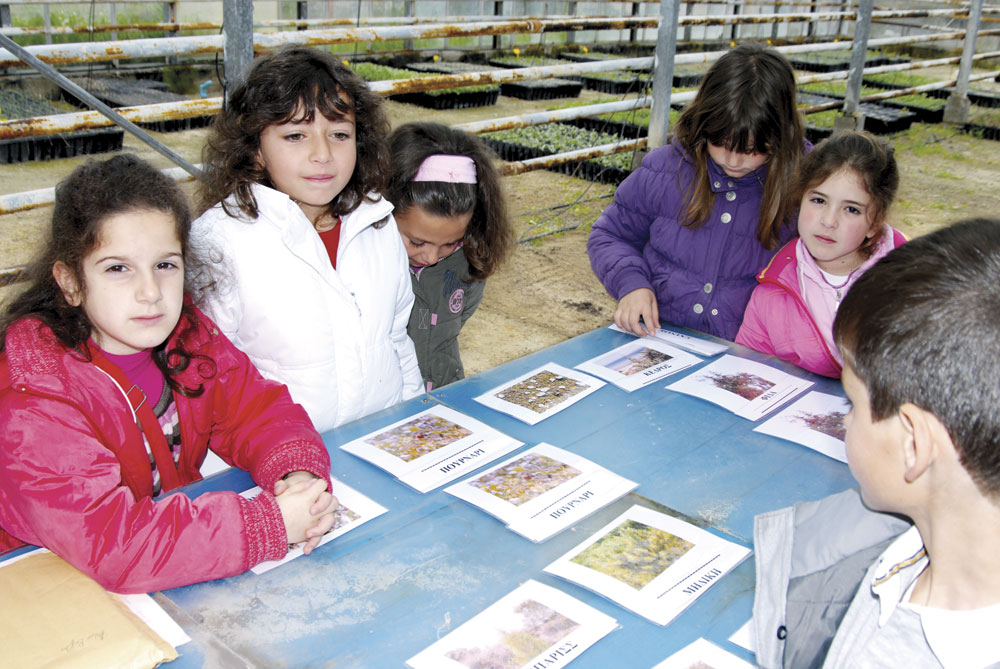
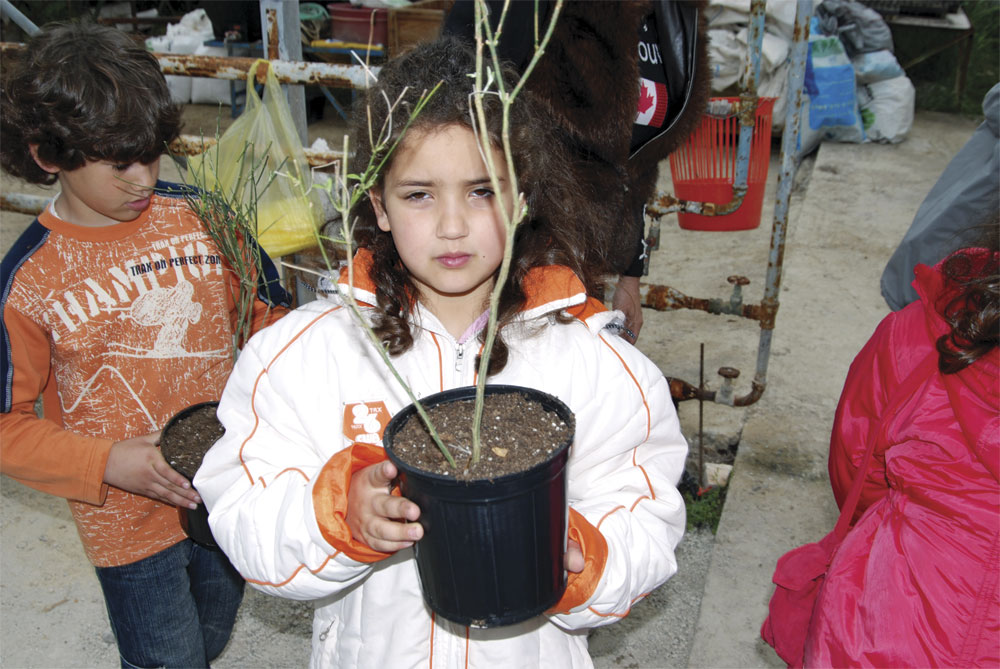
- Aims to raise awareness among the Milos students about the endemic flora of the island, as well as educate them about the local plants “of their back yard”, so as to make them appreciate their intrinsic value and protect and preserve them
- The program is eligible for inclusion in the “flexible educational zone activity” of Greek schools, where environmental education is also taught.
See a video from the program:
Photos from the program:
2006 – to the present
Instructive and entertaining activity: Minerals in our lives
Industrial minerals – our world is made of them
How are minerals mined today? Which are the most common mineral mining practices? What are the uses of minerals in our daily life? How did our ancestors use minerals? What are the prospects for professional careers in the field of minerals worldwide? Are mining companies environmentally responsible?
This educational CD-Rom replies to and elaborates on these and many other questions.
This CD-Rom successfully introduces museum visitors to the field of industrial minerals in an entertaining and timely manner.
Stony, a prehistoric hero, is here to explain the uses of minerals through the ages.
This CD-Rom is also available at the museum shop.
Copyright IMA – Europe. The European Industrial Mineral Association.
Επιμέλεια – χορηγία έκδοσης στα ελληνικά: S&Β Βιομηχανικά Ορυκτά Α.Ε.
12/01/2006 — Minerals in our lives
How are minerals mined today? Which are the most common mineral mining practices? What are the uses of minerals in our daily life? How did our ancestors use minerals? What are the prospects for professional careers in the field of minerals worldwide? Are mining companies environmentally responsible?
This educational CD-Rom replies to and elaborates on these and many other questions.
This CD-Rom successfully introduces museum visitors to the field of industrial minerals in an entertaining and timely manner.
Stony, a prehistoric hero, is here to explain the uses of minerals through the ages.
This CD-Rom is also available at the museum shop.
Copyright IMA – Europe. The European Industrial Mineral Association.
Επιμέλεια – χορηγία έκδοσης στα ελληνικά: S&Β Βιομηχανικά Ορυκτά Α.Ε.
12/08/2005 — Transplanting of a local plant species.
It is mainly designed for children and teenagers visiting the museum. This educational activity aims first to get children to know the museum, and also to ensure that their active involvement becomes a pleasant, creative experience.
In the land reclamation exhibition area, each child is invited to fill out an educational questionnaire, mainly based on the observation of information related to the environment and plants of Milos.
Further on, through written instructions, children are given the opportunity, to plant in a pot one of the Milos’ plant species, using peat and perlite products, and keep it as a souvenir of their visit to the Museum.
In the same area one can also find an entertainment activity, with games and puzzles, with themes from flowers and mines of Milos.
12/02/2005 — Educational program titled “Rock, mineral, ore: Their role in our daily life”.
In the context of its educational programs, Milos Mining Museum, in cooperation with the Crafts and Industries Educational Museum, situated in Lavrion, organized an educational program titled “Rock, mineral, ore: Their role in our daily life”.
About 350 pupils from primary and secondary schools of Milos attended successfully the program within the period from February 10 to March 18, 2005. A total of 15 educational sessions per school grade were held, each of them with a duration of one hour and a half.
This specific educational program has been sponsored by S&B Industrial Minerals S.A. since October 2003 and, apart from Milos, it was also carried out in Lavrion Mineralogical Museum, with the participation of pupils from Attica.
The educational programs Dept. of the Crafts and Industries Educational Museum was responsible for the implementation of the program in Milos Mining Museum. The pupils of Milos acted as researchers: they “discovered” the natural properties and features of minerals from the collections of the Museum and linked each mineral to its use in daily life, thanks to various museum-educational activities, according to their school grade.
More specifically, the objectives of the program for pupils of grade 2, 3 and 4 of Primary School, were:
- To understand the concepts of ground, underground, rock, mineral and ore.
- To make the connection between certain minerals of the Mining Museum and objects of daily use.
- To make a mock-up of a mineral, using materials that contain powder of these minerals (e.g. blue powder of azurite).
The objectives of the educational program for the pupils of Primary School grades 5 and 6, were similar to those of lower grades, the only difference being that older pupils used written sources and samples from the museum’s collections in order to understand the concepts ‘rock’, ‘mineral’ and ‘ore’. Afterwards, they collected information (e.g. color, shine, shape, origin etc) on minerals of Milos from the exhibits of the museum. Then, they identified and displayed their use in man’s daily life, in the context of a matching activity. Finally, the pupils used clay to make a mock-up of a mineral.
The objectives of the program for the High-School students were as follows:
- To understand the concepts of rock, mineral and ore.
- To connect certain minerals of the museum to products used in daily life.
- To organize their own workshop to measure the natural properties of the minerals they studied (e.g. hardness). In this case too, pupils worked as researchers, since they had written sources and samples from the museum’s collections available, in order to understand the new concepts. Following that, they used the museum collections as sources, and made comparisons among minerals on the basis of observations. Students, then, in a laboratory which had been organized in an auxiliary room of the museum, made experiments on the natural properties of the minerals. Finally, they connected once again the minerals to their role in man’s life, matching each one of them to objects and products we all use daily.
Upon completion of the educational activities, the pupils were invited to continue research, in order to gather and organize a collection of rocks, minerals and ores of Milos, with the purpose of exhibiting them in their school.
12/01/2003 — Mosaic-making
The “Mosaic creation” educational program included 4 courses, of 108 hours total duration, with the participation of 35 children from Milos, aged from 9 to 15. The person in charge of the educational activity was Mr. Antonis Lionis, graduate of the School of Fine Arts, professional maker and conservator of mosaics.
The educational program included the following units:
- Introduction to the creation of a mosaic – getting familiar with the natural tesserae (pebble, stones).
- Mosaics techniques – making mosaics on frames.
- Brief reference to the Milos mosaics.
When the courses were completed, the children’s works were displayed for a period in one of the museum’s exhibition areas.
12/01/2002 — Pottery-making
The “Ceramics for children” educational program included 4 courses, of 140 hours total duration, with the participation of 62 children from Milos, aged from 9 to 15. Mrs. Bronwyn Katri, a ceramist from Australia, with long experience on respective educational programs in Greece and abroad, was in charge of the education.
The educational program included the following units:
- Introduction to the concept of clay, with reference to the Milos’ minerals.
- Presentation of the different stages of forming the clay into shapes.
- Decoration.
- Screening of educational films.
- Visit to Mrs. Katri’s ceramics workshop in Adamas.
Upon completion of the program, the children’s ceramics were displayed for a period in one of the museum’s exhibition areas.
12/01/2000 — Internet access and web navigation training lessons
The “Round of the world in 2 hours” educational program was designed for children and adults. Lessons were held in summer time, daily, during the afternoon working hours of the museum. Participants could be guided by an adequately trained individual, S&B’s associate.
12/01/1999 — Painting courses – Participation of Milos children in annual Nationwide Children’s Drawing Contest.
In cooperation with the Museum of Greek Children’s Art, aesthetic education seminars were held, for Milos’ school and kindergarten teachers; Mrs. Yota Kalliakmanis was responsible for the program and education, a painter – educator, in charge of the M.G.C.A.’s educational department.
During the program, pupils of Milos’ primary schools participated in two Nationwide children’s Drawing Contests: “A journey into the depths of the earth” in 2000, and “These flowers are for you” in 2001. Twelve children from Milos gained distinction for their works, while all students received a Diploma of participation.
The children’s works were displayed for a period in one of the museum’s exhibition areas.